
The clean energy movement
The U.S. guide to plug‑in and Plug N Play solar.
Why the European "balcony solar" idea belongs on an American lawn, deck, or patio rather than on a railing, and how a plug-in kit goes in.
- Zero roof holes
- Plugs into a standard 120V outlet
- 45-minute DIY setup
The movement
From European balcony solar to American backyard power.
What started as balcony solar
Over one million households in Europe embraced the Balkonkraftwerk: one or two 400 W to 800 W panels hung from an apartment railing and plugged straight into a standard wall socket. It proved that everyday homeowners and renters can cut power bills without hiring utility contractors.
Why America needs a ground mount
Most American families do not live in high-density flats with narrow metal railings. We have yards, lawns, patios, and open sunshine. That is why the United States has settled on its own terms, plug-in solar and Plug N Play solar: the same plug-in simplicity, engineered for open ground.
How it works
Plug-in simplicity in four steps.
Plug-in solar works like a home appliance in reverse. Instead of consuming power, it produces daytime electricity and feeds it into an outdoor branch circuit.
Capture the sun
One to four standard solar panels sit on an adjustable ground frame on your lawn, deck, or patio and collect direct sunlight at ground level.
Convert with a microinverter
A certified microinverter converts the panels’ direct current (DC) into 120V alternating current (AC), synchronized to your household power.
Plug into a 120V GFCI outlet
An outdoor-rated cord plugs straight into an existing 120V GFCI wall receptacle.
Offset your base load
The power flows to your daytime base loads first (refrigerators, internet routers, circulation pumps, home office electronics), slowing the utility meter before any paid grid power is drawn.
Direct comparison
Rooftop solar vs. Plug N Play solar.
Total cost
- Rooftop
- $25,000 to $40,000+ (a 20 to 25 year loan)
- Lawn Lizard
- Under $1,500 complete (rapid payback)
Installation time
- Rooftop
- 3 to 6 months of contractors and permits
- Lawn Lizard
- 45-minute DIY setup (plugs into a wall outlet)
Roof impact
- Rooftop
- 30 to 50 lag bolt penetrations (leak risk)
- Lawn Lizard
- Zero roof contact (ground or patio based)
Tilt optimization
- Rooftop
- Permanently fixed to the roof slope
- Lawn Lizard
- Seasonal tilt adjustment (six stops, 20° to 45°)
Portability
- Rooftop
- Fixed to the structure when you sell
- Lawn Lizard
- 100% portable (unplug and take it if you move)
HOA approval
- Rooftop
- Frequent architectural battles
- Lawn Lizard
- Low-profile, non-permanent lawn fixture
Safety and the law
Certified safe, and legal in a growing list of states.
UL 1741 and UL 3700 safety
Plug-in microinverters carry rapid-shutdown and anti-islanding protection to UL 1741, and UL 3700 is the standard written for plug-in solar itself, published in December 2025. If the cord is unplugged or the utility grid loses power, output stops in milliseconds, so the plug is never live in your hand and nothing feeds back toward a line worker.
States are treating plug‑in solar like an appliance
Utah passed the first plug-in solar law in 2025, and Maine, Virginia, Colorado, Maryland, Connecticut, New Hampshire, Vermont, and New Jersey followed in 2026: certified systems under 1,200 W count as ordinary household appliances, exempt from utility interconnection agreements and fees. Rules still vary by state and utility, so check yours before you plug in.
Hardware spotlight
Engineered specifically for real lawns.
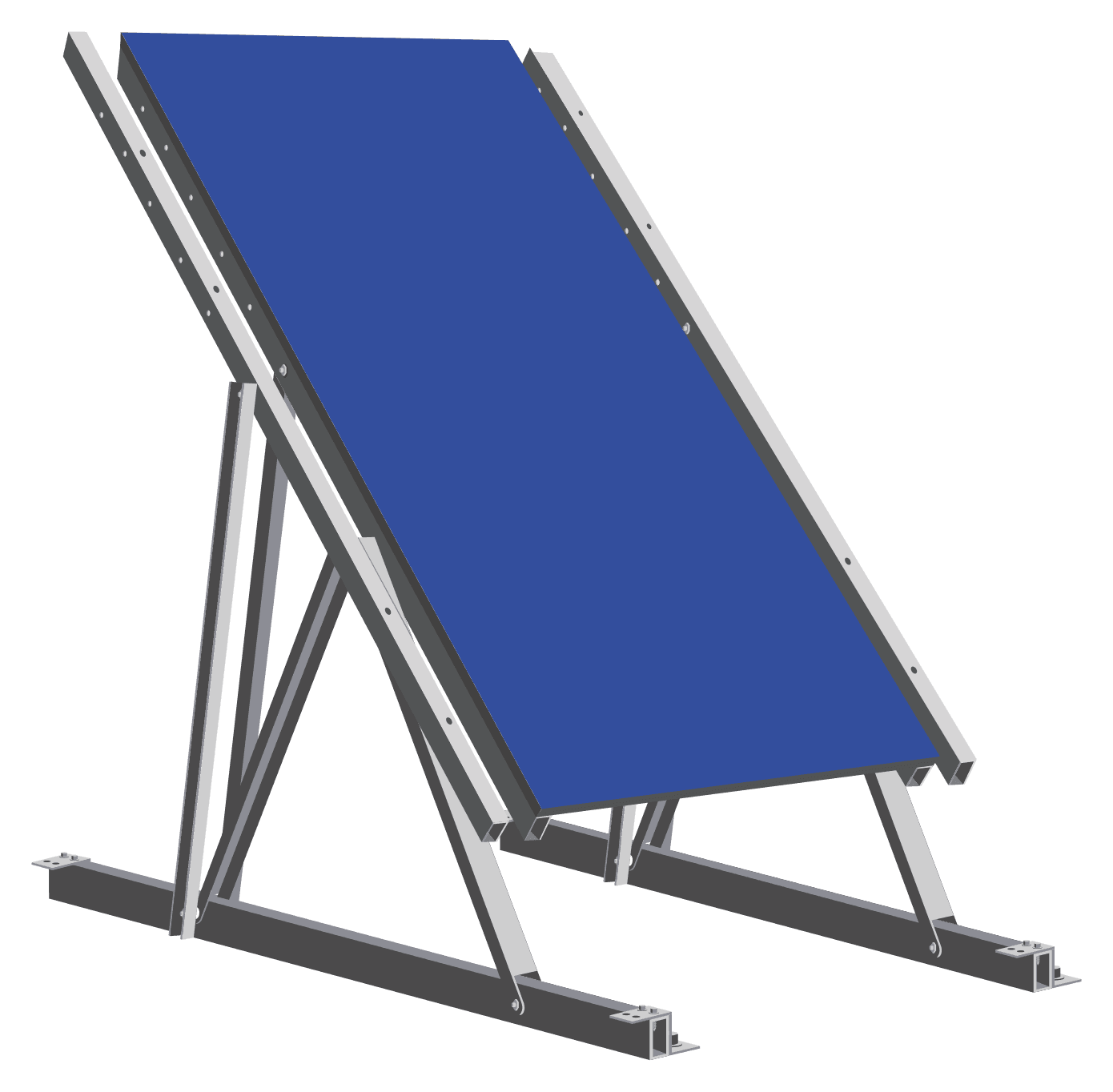
Imported balcony solar kits ship with lightweight hooks meant for apartment railings, which have nothing to hold on to in an American yard. The Lawn Lizard provides the missing ground-mount infrastructure.
Elevated ground clearance
Balcony brackets sit in wet grass or tip over. The Lawn Lizard keeps panels elevated above wet sod, standing water, grass clippings, string trimmers, and lawn mower passes.
Seasonal tilt in minutes
Six precision settings from 20° to 45°. Flatten the array for summer sun and steepen it for winter to capture up to 25% to 50% more winter energy.
Screwed into the ground, not weighted down
Two ground screws or earth anchors per frame, driven with a drill. No ballast blocks, no concrete, no digging. Rated up to 185 MPH wind and 100 PSF snow in S350GD steel with a ZAM coating.
Fits the panels you already have
Works with most solar panels up to 94″ in length, in portrait, with any microinverter brand.
FAQ
Questions we hear most.
Is plug-in solar legal in the United States?
In a growing number of states, yes. Utah passed the first plug-in solar law in 2025, and Maine, Virginia, Colorado, Maryland, Connecticut, New Hampshire, Vermont, and New Jersey have followed with nearly identical laws treating certified systems under 1,200 W as household appliances that need no utility interconnection agreement. The microinverter has to be certified (UL 1741 and UL 3700), and rules vary by state and utility, so check yours.
What is the difference between balcony solar and plug-in solar?
Electrically, none: the same microinverter and the same 120V outlet. "Balcony solar" is the European term, where the panels clamp to an apartment railing. In the U.S. the systems are called plug-in solar or Plug N Play solar and sit at ground level, on a patio, or across an open yard on purpose-built racking.
Can plug-in solar overload my outlet or cause an electrical fire?
A certified microinverter de-energizes within a fraction of a second when it is unplugged or the grid goes down. A single 400 W to 1,200 W array on an outdoor GFCI outlet feeds daytime base loads without exceeding residential wiring limits.
Can a Plug N Play solar kit run an entire home?
No. A 400 W to 1,200 W array is sized to offset your home’s continuous base load: refrigerators, internet routers, computers, and standby devices. For most homes that is 15% to 30% of daytime consumption.
What happens during a blackout?
Grid-tied microinverters shut off during a utility outage to protect line workers (anti-islanding). Pairing the array with a portable power station or a home battery gives you emergency power when the grid is down.
Put your lawn to work.
Cut out contractor markups and roof loans with America’s premier adjustable ground-mount racking system. Start small, set up in minutes, and let your yard work for you.